
Cluster Flies on Sunny Walls: A Missouri Guide
Cluster flies gathering on your sunny walls before the first freeze? Learn why it happens and how Barricade Pest Control can help in Lee's Summit and beyond.
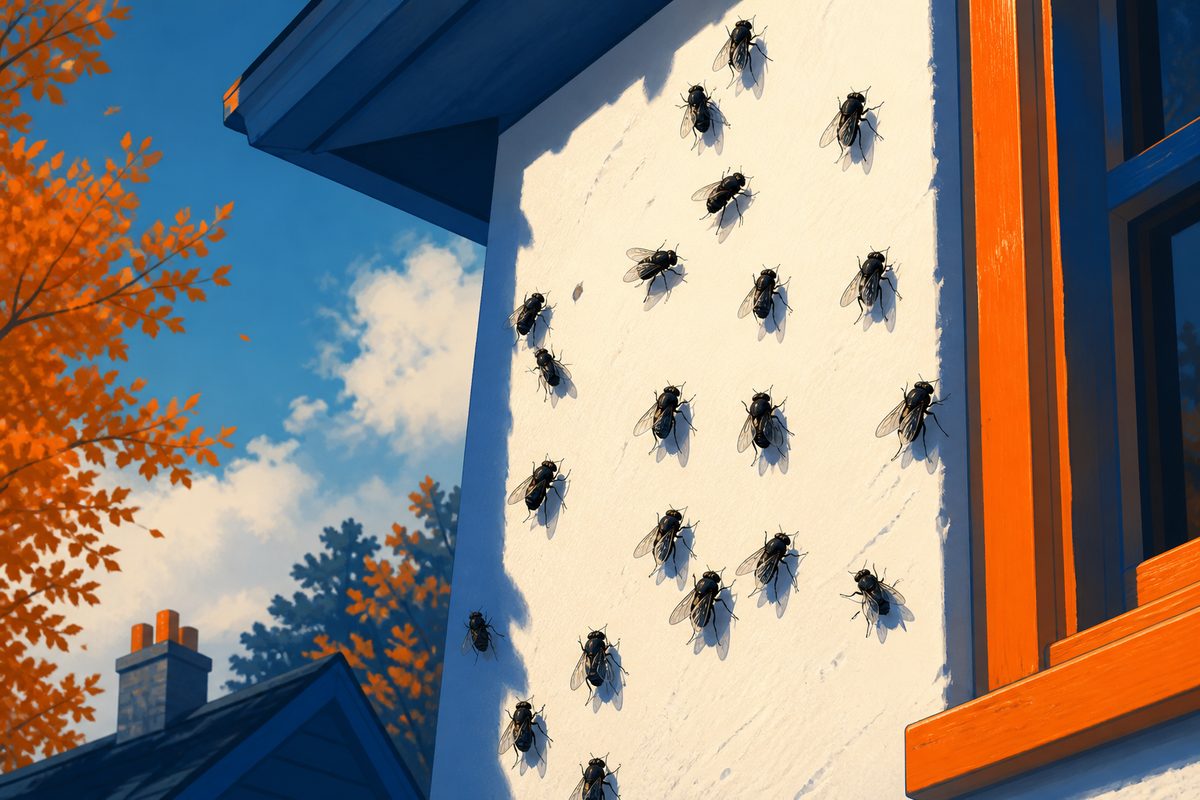
There is a window of a few weeks every fall, right before the first hard freeze hits the Kansas City metro, when cluster flies decide your house looks like a great place to spend the winter. If you've stepped outside on a warm October afternoon and found hundreds of slow, sluggish flies pressed against your south or southwest-facing wall, you are not imagining things. It's a real phenomenon, it happens all across Missouri, and it's one of the more common fall calls we get here at Barricade Pest Control.
What Is a Cluster Fly, Exactly?
Cluster flies (Pollenia rudis, if you want the science name) look a lot like house flies at first glance, but there are a couple of differences you'll notice up close. They're a little bigger and darker. They move slowly, almost lazily. And they have a distinctive golden, bristly fuzz on their thorax. That sluggishness is a clue: these things are already half-checked-out for winter. They're not buzzing around looking for your lunch. They're looking for a wall that's warm.
Their life cycle is tied to earthworms. Larvae develop as parasites inside earthworms in the soil, then adults emerge in late summer and start hunting for a place to overwinter. That place is usually a structure with good sun exposure and some warmth to offer.
Why Your Wall, Why Now?
The timing of that cluster on your siding is not random.
Cluster flies are cold-blooded. When nighttime temps start dropping into the 40s and daytime temps are still hitting the 60s or low 70s, they go looking for thermal mass. A brick wall or vinyl siding on the south or southwest face of a house absorbs heat all afternoon. To a cluster fly, that surface is a signal: warmth is here, and winter is coming.
This is what people in Lee's Summit, Blue Springs, and out in Greenwood or Raymore tend to notice first, those sunny walls covered with flies on a mid-October afternoon, right before the first killing freeze. It's the transitional period that triggers mass congregation.
Once temperatures drop enough, the flies that haven't died off move into wall voids, attics, and other protected spaces inside the structure. That's when homeowners start seeing them inside the house, especially on warm winter days when heat from inside the structure rouses them from their dormant state.
The Indoor Problem Nobody Expects
Here's the part that catches people off guard. You deal with the flies on the outside wall and forget about it. Then January rolls around. You get a few warmer days, your furnace is running, and suddenly you've got a couple dozen flies crawling on your windows, bumping into your lights, and dying on your windowsills.
That's the overwintering population waking up. They're not new flies. They're the ones that made it inside back in October. And they will keep doing this on every warm-ish winter day until spring.
By the time spring arrives, the survivors fly out and the cycle starts over in your lawn, in the soil, with earthworms.
What Makes Them Hard to Manage on Your Own
A few things work against the typical DIY approach:
Timing is everything. You need to treat before they move inside, not after. Once they're in wall voids and attic spaces, the problem is much harder to address.
Cluster sizes are deceptive. A wall covered in flies looks like hundreds. What's already moved inside can be thousands. The congregation on the outside is the visible tip of the problem.
Over-the-counter sprays don't reach the right places. A can of bug spray knocked on the wall might knock down a portion of the flies you can see. It won't address the ones already inside the structure.
How Barricade Pest Control Handles Cluster Flies
We get calls about this every fall from homeowners all over our service area, Lake Lotawana, Raintree Lake, Creekmoor, Lakewood, Lake Winnebago, Grandview, Raytown, Belton, and everywhere in between. The approach we use is timed exterior treatment of the areas where flies congregate before they move inside.
Our General Pest Control service covers cluster fly treatments. We use EPA-registered products applied to the exterior surfaces and harborage points where flies gather. The timing matters: mid to late September through mid-October is the window that makes the biggest difference for most of Missouri. That's when the flies are on the move but haven't yet pushed deep into wall voids.
For homes that have dealt with this for multiple years in a row, we'll talk through an annual treatment schedule that gets ahead of the problem rather than reacting to it.
What About Kids and Pets?
We apply EPA-registered products strictly per label, and those labels specify re-entry times for a reason. Before we pack up and leave, we walk you through exactly when kids and pets can come back to treated areas. No guessing, no vague timelines.
Other Fall Pests Worth Watching
Cluster flies aren't the only thing trying to overwinter in your home right now. Boxelder bugs and brown marmorated stink bugs use the same warm-wall strategy in the same window of time. If you're seeing cluster flies on your south wall, take a look around the rest of the exterior because you may have more than one species making the same move.
Barricade Pest Control's General Pest Control service covers these overwintering invaders as part of a broader fall treatment.
Get a Free Quote Before the Freeze
The window to treat cluster flies effectively is short, and once that first hard freeze hits the Kansas City area, the flies that haven't died have already moved inside. Don't wait until January when you're watching them crawl across your windows.
Call Barricade Pest Control at (816) 777-8903 or visit our contact page to get a free quote. We serve Lee's Summit, Blue Springs, Raymore, Belton, Lake Lotawana, Lake Winnebago, Lakewood, Raintree Lake, Creekmoor, Raytown, Grandview, Greenwood, and the greater Kansas City, Missouri area. Let's get ahead of this before the freeze locks them in for the winter.
Why are cluster flies covering my south-facing wall?
They're chasing warmth. Cluster flies are cold-blooded, so when fall temperatures drop, they press against sun-warmed surfaces to absorb heat before moving into a structure to overwinter.
Are cluster flies dangerous to my family or pets?
They don't bite and they don't spread disease the way house flies do. The problem is sheer numbers and the greasy smear marks they leave on walls and windows.
What about my kids and pets after a treatment?
We apply EPA-registered products per label, and those labels include specific re-entry times. We walk you through exactly when it's fine to bring kids and pets back inside before we leave.
Will cluster flies come back next year?
They can. Flies that overwinter successfully often return to the same structure the following fall. Annual preventive treatments timed to late summer or early fall break that cycle.
Do you serve my neighborhood?
Barricade Pest Control covers Lee's Summit, Blue Springs, Raymore, Belton, Lake Lotawana, Lake Winnebago, Lakewood, Raintree Lake, Creekmoor, Raytown, Grandview, Greenwood, and the greater Kansas City, Missouri area.
See our full lineup of pest control services or check out the areas we serve.